
Why Kierkegaard Would've Ignored Your Texts
The Neuroscience of Delayed Gratification

According to Søren Kierkegaard, the anticipation of a desired event often exceeds the pleasure derived from the event itself, and so he suggested ways of drawing out the anticipation. One such suggestion is to leave all of your mail for three days before opening it. Today, just imagine delaying the checking of your Instagram notifications. While unplanned events can often lead to pleasures as great as anticipation, the pleasure of planned events is entirely rooted in anticipation.
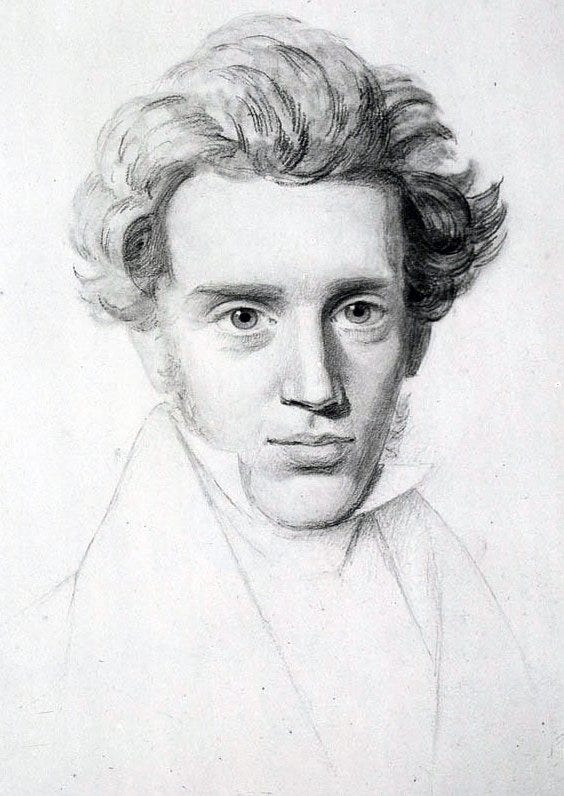
It's actually incredible how Kierkegaard's idea can be paralleled with certain aspects of the neurobiology of dopamine in our brains. As we know, dopamine is a neurotransmitter associated with the brain's reward system and plays a crucial role in motivation, pleasure, and anticipation. It thrives on uncertainty and delay, and by resisting the urge to immediately resolve desire, we can amplify the emotional richness of an experience.
Dopamine is released not only when a reward is received but also during the anticipation of a reward. This anticipation phase, with increased dopamine activity, can often evoke stronger feelings of pleasure and motivation compared to the reward itself. This “dopaminergic anticipation” evolved to drive exploration and surviva back then, but in our hyper-stimulating world today, it’s constantly hijacked by endless notifications.
So basically, Kierkegaard’s unread letters find their 21st-century counterpart in the red dot of a social media notification. Several studies have shown that people check their phones 96 times a day on average, driven by something called the “phantom vibration syndrome” which is a conditioned craving for micro-rewards.
Thankfully, research also suggests that delaying gratification can recalibrate this cycle. Kierkegaard’s philosophy was about reclaiming agency over attention. Modern psychology supports this:
The “Peak-End” Rule (Kahneman, 1999): We remember experiences based on their emotional peaks and endings. Prolonging anticipation creates more “peaks”.
Temporal Discounting (Loewenstein, 1987): We undervalue future rewards. Delaying small gratifications (like our notifications) trains the brain to resist the bias.
In an era where (unavoidable) apps exploit our dopamine loops, Kierkegaard’s advice is both a survival tactic and a rebellion. We quite simply need to learn to let the notifications and emails linger a little longer. As he wrote:
“Patience is necessary and one cannot reap immediately where one has sown.”
References:
Berridge, K. & Kringelbach, M. (2009). Affective neuroscience of pleasure. Current Directions in Psychological Science.
Kierkegaard, S. (1843). Either/Or: A Fragment of Life.
Kushlev, K. (2020). The social media see-saw: Positive and negative influences on well-being. Social Psychological and Personality Science.
Mark, G. (2014). Batching email notifications reduces stress. Computers in Human Behavior
Sapolsky, R. M. (2017). Behave: The bestselling exploration of why humans behave as they do. Random House.
Schultz, W. (1997). Dopamine neurons and reward mechanisms. Journal of Neurophysiology.
Thanks for another relevant piece, Aatish. In today's age of Dopamine hits, we are well served by Kierkegaard's wisdom and suggestions to delay gratification.🙏💫🙂