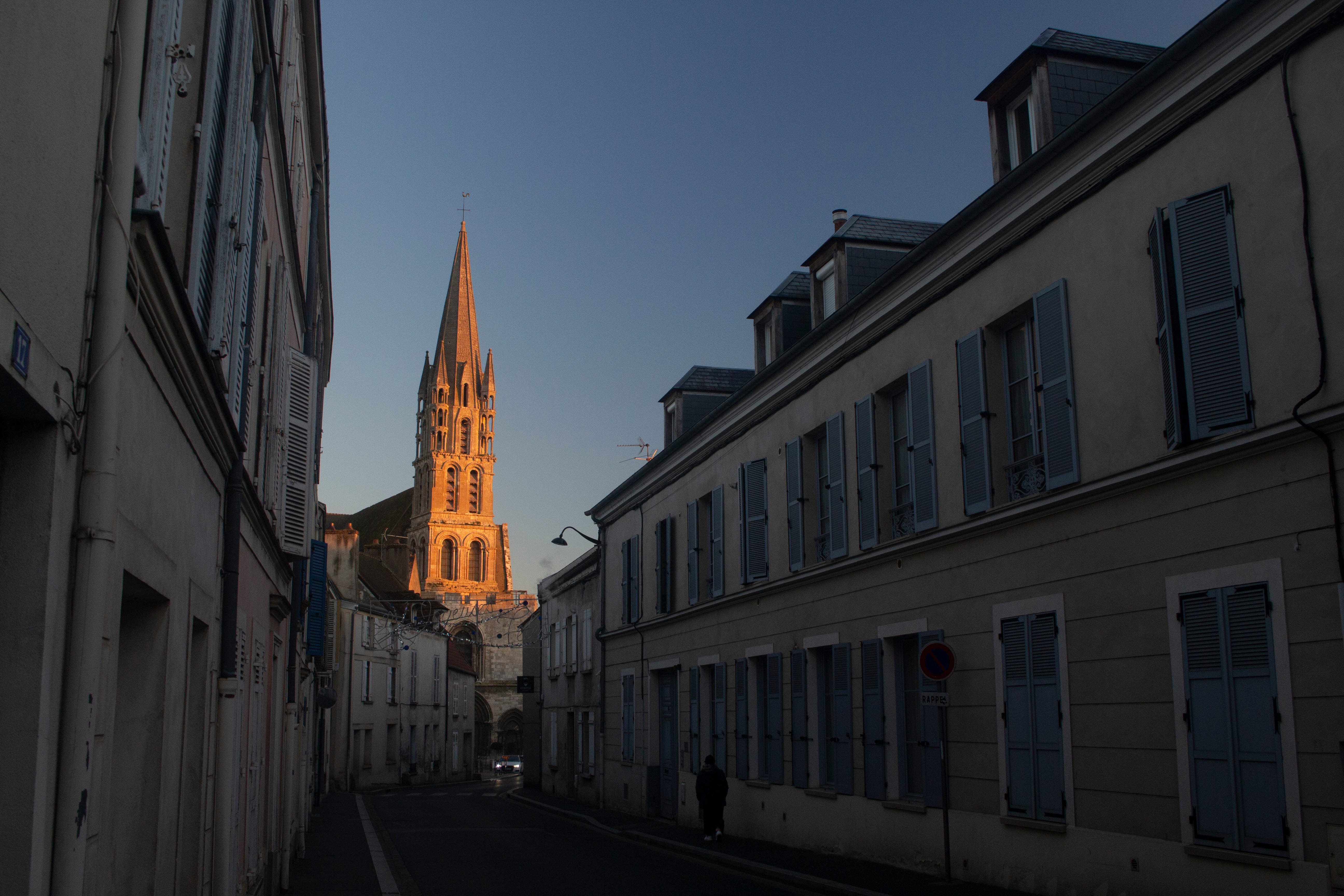
Gothic cathedrals do something fascinating to human perception: they force your gaze upward. The pointed arches, the ribbed vaults, the impossibly tall columns, the spires that pierce the sky. Everything about their design fights against the horizontal world we normally inhabit. Standing inside Saint-Germain-des-Prés or walking around the exterior of any other cathedrals in Paris, I become acutely aware of how much of my daily life happens in a plane parallel to the ground. I look at screens, I look at other people’s faces, I look at the street ahead of me. I almost never look up.
The spire is the cathedral’s ultimate expression of this vertical impulse. It serves no practical function. It doesn’t make the building more stable or increase its capacity. It exists purely to reach, to point, to extend beyond what is necessary into what is aspirational. When I visited the cathedral in Gisors, I watched how the spire changed against different backgrounds of sky. On a clear day, it would cut into the blue like a blade. On an overcast afternoon, it disappeared into gray, becoming almost abstract.
This vertical orientation reminds you of scale, of your smallness, of the vast distance between where you stand and where your eyes are being pulled. The philosophers of the 18th century would eventually call this feeling the sublime: that mixture of awe and terror we experience when confronted with something that exceeds our capacity to fully comprehend it. Mountains. Oceans. Storms. And yes, cathedrals.
I’ve been reading Carlos Eire’s They Flew, his scholarly examination of levitation and bilocation accounts in early modern Catholicism. The book catalogs hundreds of documented cases of saints and mystics who, witnesses claimed, defied gravity during states of religious ecstasy. Teresa of Ávila, Joseph of Cupertino, dozens of others. Eire isn’t really arguing for or against the reality of these phenomena. Instead, he explores what it meant for people to believe these things could happen.
In a world where the physical and spiritual were understood as intimately connected, where the divine could break through into ordinary reality at any moment, levitation made a certain kind of sense. If God could become flesh, if bread could become body, if saints could intercede across the boundary of death, then gravity, too, might be negotiable. The peasant entering a cathedral in 1326 entered a space explicitly designed to demonstrate this logic. The stones themselves seemed to defy their own weight. The vaults spread across impossible spans. The walls dissolved into glass. The building escaped the horizontal plane.
I think about this whenever I’m in these spaces now. That peasant and I are looking at the same arches, the same proportions, the same light diffusing through ancient glass. But we’re not having the same experience. Or maybe we are, and I’ve just been trained to translate it into secular language. When I feel that tightness in my chest standing under those vaults, when I feel simultaneously small and elevated, when the boundary between inside my body and outside it becomes briefly uncertain, what am I experiencing if not transcendence?
In Bruges, I remember visiting the Church of Our Lady, home to Michelangelo’s Madonna and Child. But I barely looked at the sculpture. I couldn’t stop staring at the brick. The way the Gothic builders used ordinary fired clay to create these soaring spaces. The way they developed the pointed arch and the flying buttress, which are incredibly beautiful. This is what moves me most about Gothic architecture: Did it begin with an aesthetic vision? Or with a problem? How do you build taller? How do you let in more light? How do you create a sense of heaven? Were the innovations practical and the sublime just accidental? Maybe the desire to build higher was always about more than structural ambition.
Carlos Eire’s levitating saints were trying to express something that exceeded language. The body lifted because the soul couldn’t be contained. The mystics described an experience of divine union so overwhelming that their physical form simply ceased to obey its usual rules. Whether or not you believe the accounts, you have to reckon with the experience they’re trying to articulate: the sense that reality has more dimensions than we normally perceive, that there are states of consciousness that reorganize our relationship with the physical world. Gothic cathedrals are the architectural equivalent of that testimony.
What am I looking for in these spaces? Not religion, not even beauty, though they’re beautiful. I think I’m looking for the same thing the builders were reaching toward, the same thing the peasant recognized, the same thing the levitating saints couldn’t contain: the experience of being pulled beyond myself, of encountering something that exceeds my explanatory frameworks.
The sublime isn’t comfortable. It’s not meant to be. When you look up at a vault that disappears into darkness, when you stand at the base of a spire that seems to puncture the sky itself, you’re supposed to feel small. You’re supposed to feel the inadequacy of your normal ways of understanding the world. You’re supposed to be reminded that your usual scale isn’t the only scale.
Immanuel Kant distinguished between the beautiful and the sublime. The beautiful, he said, gives us pleasure through harmony and proportion. The sublime gives us pleasure through overwhelming us, through presenting something so vast or powerful that it defeats our ability to fully grasp it. Beauty fits comfortably within our usual perceptual and cognitive frameworks. The sublime shatters them.
Gothic cathedrals traffic in the sublime. They’re too tall, too ambitious, too determined to escape the weight of stone. They shouldn’t still be standing after centuries, and yet here they are. And we shouldn’t still be moved by them in an age of skyscrapers and space stations, and yet we are.