
I thought I lived
On art, refuge, and the courage to finally participate

I thought I lived behind the pages of books with Gregor Samsa, with the innocent and naive David Copperfield and condescending James Steerforth, with the radiant Dorian Gray and Hedonic Lord Henry, with the meek and pious Sonya, and the alienated and self-loathing Rodion Raskolnikov.
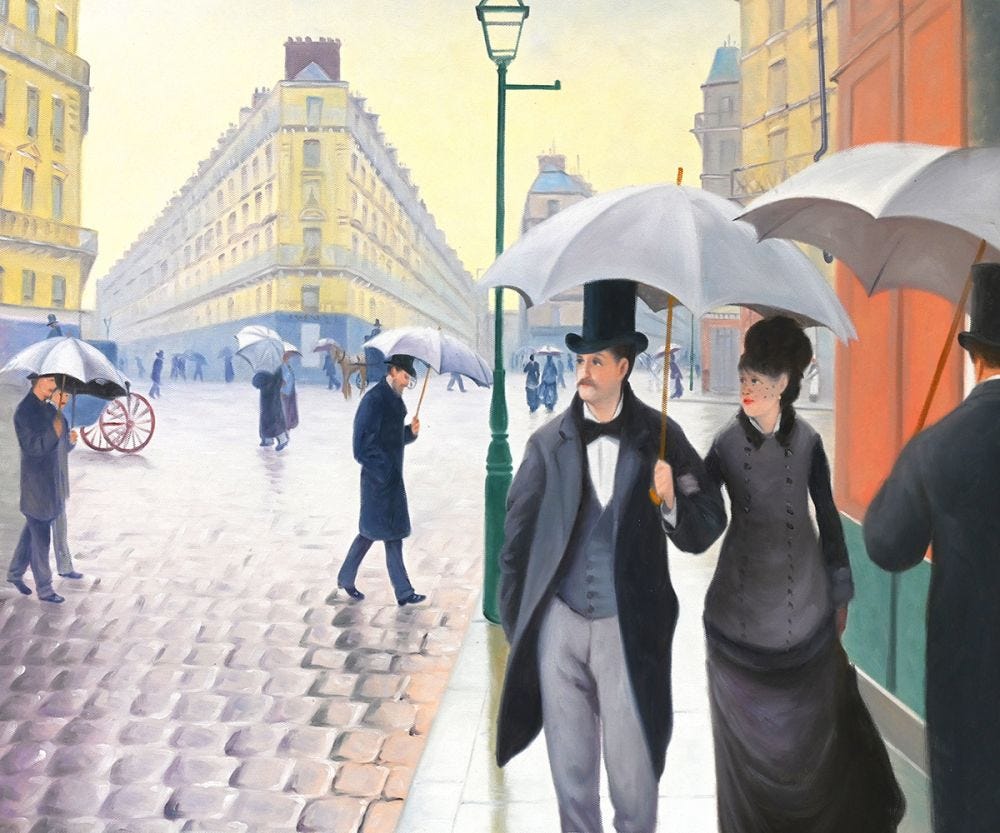
I lived behind the canvas of paintings, with Da Vinci’s La Bella Principessa, with the Melancholy of Edvard Munch, On the Paris Street of Gustave Caillebotte, in the Balcony of Edouard Manet and Caspar David Friedrich’s Wanderer above the Sea of Fog.
I thought I lived behind the musical compositions, with the long laments of Max Richter’s On the Nature of Daylight, with the cheerful Four Seasons by Antonio Vivaldi, and Rossini’s devilish and dramatic Thieving Magpie.
I thought I lived in these borrowed worlds, these curated refuges of feeling and form. Perhaps we all do, for a time. We find ourselves in the eyes of characters who suffer more eloquently, who love more recklessly, who stand at precipices we dare not approach in waking life.
But there comes a moment when the canvas no longer holds you. When the page turns and you are not carried with it. I began to wonder: had I been living, or had I been hiding? Had these great works illuminated my existence, or had they become a veil, a beautiful obstruction between myself and the unvarnished texture of my own days?
There is a comfort in aesthetic distance. Art asks nothing of us but our attention. It does not demand that we act, that we risk, that we fail. We can weep for Sonya’s sacrifices without sacrificing anything ourselves. We can feel the ache of Richter’s strings without confronting the source of our own grief.
Yet something shifted. Perhaps it was the accumulation of years, or the weight of a life conducted primarily in the subjunctive. Perhaps it was Paris itself, a city that refuses to let you remain merely a spectator, that pulls you onto its streets and forces you to participate in its theatre of daily life.
I realised that the figures I had loved, the Davids and Swanns and Dorians and Rodions, were not meant to be dwelt with indefinitely. They were meant to be companions for a passage, teachers for a season. They show us what it means to feel deeply, to err profoundly, to seek meaning in a world that offers none readily. But they cannot live for us.
And so I stepped out from behind the canvas, and out from between the pages. Not to abandon these companions, but to finally stand beside them. To become, at last, a figure in my own composition. Imperfect, unfinished, but present.
this is gorgeous!
been feeling this exact thing this whole week. glad I read this. beautifully written.